
Do We Need Psychedelic Judaism?

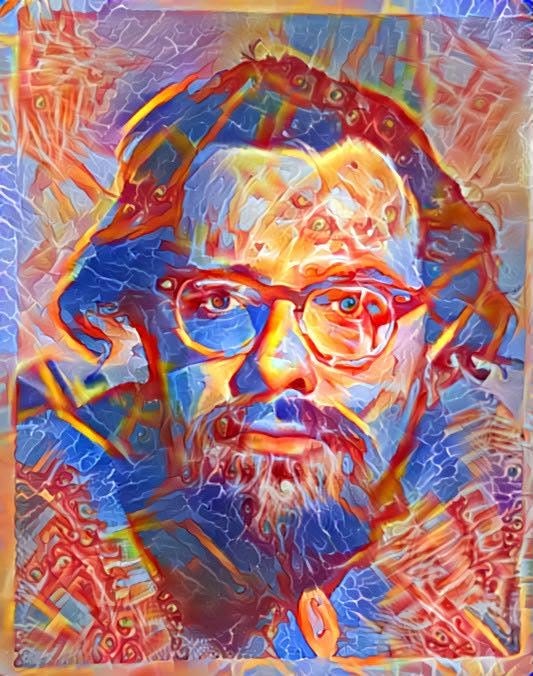
Within hours of each other, a former congregant and an old friend independently sent me a PDF of Shefa’s Elucidated Edition of Reb Zalman’s “The Ba’al Shem Tov’s Aliyath Han’shama and the LSD Experience,” which I assume is making the rounds online.
It’s a powerful document, unpacking a 1963 experience in which Rabbi Zalman Schachter (not yet the Reb Zalman Schachter-Shalomi so many know) “drove to a Vedanta ashram in Cohasset, Massachusetts, took LSD with Timothy Leary, and spent the night trying to work out whether what was happening to him was an aliyat neshama, the kind of soul-ascent the Baal Shem Tov himself once described.”
Rabbi Zac Kamenetz, founder and CEO of Shefa (“the first Jewish organization to create spaces for healing and self-discovery in community by integrating Jewish wisdom with psychedelic practices”) describes the document as “a foundational text for Psychedelic Judaism.”
In the essay, Reb Zalman asks himself: “What key can I use in order to open myself pneumatically? Where do I find the hole? Where is the bottle of drink, as it were, to make me get in there; smaller, bigger, or whatever I have to become in order to have the experience?” (7)
The answer, evidently, is not the chasidus in which Reb Zalman was so steeped: “I do not know what happened in Hasiduth, but it is interesting that when you see more disciples and you see that dynasties are being continued from father to son, that here I get a sneaking suspicion that from that moment on, the pneumatic keys are not given over anymore” (8).
He thought he found that key, somewhat unsurprisingly given the times, in psychedelic drugs like LSD. In retrospect, however, he wasn’t so sure:
First of all, was it an aliyath han’shamah? I would have sworn on the trip to New York, afterwards, that it was. Now I wouldn’t swear to it. . A) Because Iwas [sic] being swept by the experience. I didn’t go anywhere. The sense of going to a destination, raising my question with a heavenly mentor, and coming back with a specific answer from there, that is one reason.
Another reason was that it wasn’t Jewish enough for me, a universe in which everything was happening wasn’t Jewish enough. (What does that prove? Only that under LSD I did not replicate other “peak” value experiences.) That later, when I started to find, when Shabbath came, I found some things in Shabbath that weren’t in LSD, all right, but again, by that time I had stepped out and I had no real Shabbath with LSD…
And since I experienced some of this awe by consecration outside LSD, and it didn’t happen inside LSD, I was beginning to wonder, you know, this is part of the re-assesment. Now, D.L. told me, when I was in LA before the summer, that LSD caused a Jew’s conversion to Catholicism. So I said to him: “Don’t you think that we ought to come to terms, because it now is going to happen more and more? I don’t think that we’ll be able to stem the tide by saying don’t join. It is proven to be a narcotic. It’s proven not to create any havoc with the internal system, because it is so minute, uou [sic] known, of LSD that you are getting, goes into gammas. Gammas are a millionth of a gram. It doesn’t upset the liver at all. The only thing is it expands and does things to consciousness. It is bound to be taken by more and more people. We need to train jewish [sic] spiritual directors in the LSD experience - put our texts to use. What I would want to do, if I have the opportunity again, is to control it in the shtibel setting, with more of a Jewish paraphernalia - music - pictures, space arrangement, but I would also want to have someone who is going to be the ground control, to keep on calling attention to some Jewish program, because I was complaining before saying that it took hold of me and I had nothing to do with it. Also, I didn’t follow my plan on meditation. I was far too introspective.....I can’t be hypnotized for that reason. Too curious to find out how does it work inside. (43-45)
Psychedelic Judaism prides itself on taking Reb Zalman’s concerns seriously. As Kamenetz writes,
Reb Zalman narrates the whole night entirely within his own tradition’s terms: hitpashtut hagashmiyut, gilgulim, aliyat neshama, the live question of whether it was Jewish enough to count. Every retreat Shefa runs, every framework we build, every attempt to describe what happens when Jewish practice meets psychedelic experience has this night somewhere upstream of it.
The question I find myself asking, though, (and which even Reb Zalman seems to have asked at least briefly) is whether all of this is actually necessary? Should this be done just because it can be done?
It would be one thing if these experiences were such that they could only happen under psychedelic influence, but research has shown time and again that it need not be so. Thinkers like Sam Harris, Robert Wright, and others have written at length about how mindfulness exercises can achieve such states. Indeed, I’ve had significant success using meditative and hypnotic techniques in my own life to achieve what Reb Zalman described as the realization that “Buber is so completely wrong when he makes people discrete entities, so separate that there is always an “I” over and against the “Thou,” because we were WE rather than “I-Thouing” it. In other words, we both were part of the same field rather than of discrete and separate entities” (14) — something I may reflect on at a later time.
This brings me to the initial response I shared with my former congregant, admittedly drafted before I read Reb Zalman’s reflection in its entirety:
Without getting into any of the legal questions (which I think are pretty much resolved where Shefa operates), I’m personally of the belief that Psychedelic Judaism is unneeded. This might be an overly simplistic view, but I see the use of psychedelics in this context as a “cheat code” to try to unlock a transcendent religious experience without putting in the psychic work to get there the old-fashioned way (though it’s not lost on me that many would argue the psychedelic approach is the old-fashioned way and using mindfulness/meditation/hypnosis to accomplish it is really the innovation).
I see Reb Zalman’s reflection as useful in the sense that it gives us a destination to aspire towards naturally/meditatively, without the need to ingest foreign substances to get there. In the same way that, per the Rambam and Rav Kook, animal sacrifices were always meant to evolve into prayer, so too may the use of psychedelics be meant to evolve into psychological mindfulness in order to accomplish the same result.
Might it be helpful for some people? No doubt. Might it also be a crutch as we collectively learn more about using the power of our minds to get where we need to go? I suspect so.
Perhaps that was what the Lubavitcher Rebbe implied in taking his L’Chaim with Reb Zalman on the upcoming meditation rather than the retreat.
Coming in, the Rebbe sits and grins and he says: “Nu, gehat a retreat. Gehat a...a meditation? Trink itzter farn retreat a l’khayim un eynem far dem meditation.” I fill a cup of schnapps like so, with vodka, down the cup and said l’khayim. The Rebbe looks at me drink it and does not say l’khayim back. I down the second one of vodka, figuring this one he will say l’khayim after both the retreat and the meditation. So I finish this one and then he says to me: “Nu, itzer, zogt er, trink’t farn retreat.” And this time I took regular schnapps, and then he says: “Un itzter farn meditation.” I couldn’t anymore so I filled it up with wine and the Rebbe said “l’khayim” and grinned from ear to ear: “Zol dir voil bajumen der retreat; zol dir voil bakumen der meditation.” [“May the retreat go well for you; may the meditation be beneficial for you.”] (13)
After sharing my initial thoughts with Rabbi Kamenetz, the two of us had a back-and-forth around this subject. In his words (shared with permission), “meditating for 10, 20, 30, 60 minutes is a noble practice, and one that for most of us is a practice in coming back over and over to awareness.” Psychedelic experiences, on the other hand, provide “6, 8, 10 hours of sustained engagement with spiritual, existential, emotional, relational, religious, and theological material. We buy the ticket and we take the ride.” He asked further: “If someone has a broken leg, would you spurn them for using a crutch? If someone is struggling to get somewhere, would you rebuff them for using a shortcut?” Quoting a teacher of his, "Even the 'easy' way is hard enough."
To me, the most poignant point he raised was that in moving the conversation towards psychology but away from phenomenology, I fail to ask “what has happened in the breakdown of generations that our generation cannot access the expanded states of our ancestors?”
Perhaps, Kamenetz suggested, “instead of toiling for years to maybe receive some spark of insight or deveikus” we might be better “starting with the spark and dedicating to a life of toiling in integration” from that moment onwards. A friend made a similar point to me, comparing Psychedelic Judaism to jumpstarting a car that can then keep going by just filling up the gas with mindfulness, meditation, hypnosis, chassidus, kabbalah, or the like.
I would respond to these points largely the same way I did above. To me, the existence of an easy path need not render a harder one unnecessary. To the contrary, I see it as all the more rewarding to be able to achieve such spiritually impactful moments by utilizing the power of the human mind without the aid of additional substances and I hope that others feel the same. That, of course, is not to disparage those who feel they need to use such substances as long as it is done in a safe and controlled way.
It may well be that many people need to first get themselves to have the experience using foreign substances to then be able to re-enter that psychic place naturally. Perhaps we need to train Jewish Spiritual Directors in mindfulness, meditation, and hypnosis as much as in psychedelic facilitation. It’s not as glamorous, but that doesn’t make it any less important.
Where I agree wholeheartedly with Kamenetz and Schachter-Shalomi is that we must ask ourselves what has happened such that today’s Jews find it so hard (for many, even impossible) to reach the same spiritual heights as our religious forebearers? We must also ask ourselves the natural corollary — what we can do to shift the tide back in the proper direction? Psychedelics and mindfulness represent two very different models of course-correction, with both no-doubt serving important purposes on our collective way to redemption.
I, however, will choose to walk the more difficult path.
May we all find Truth in the way that works for us.
excellent rebuttal, Rabbi. In the sixties we used to say "reality is for people who can't handle drugs. Sadly, we have lost the ability to elevate the mundane without resorting to "short cuts". Psychedelic therapy is of the same ilk.. the very solutions we seek become the new problems.