
Modern Responsa
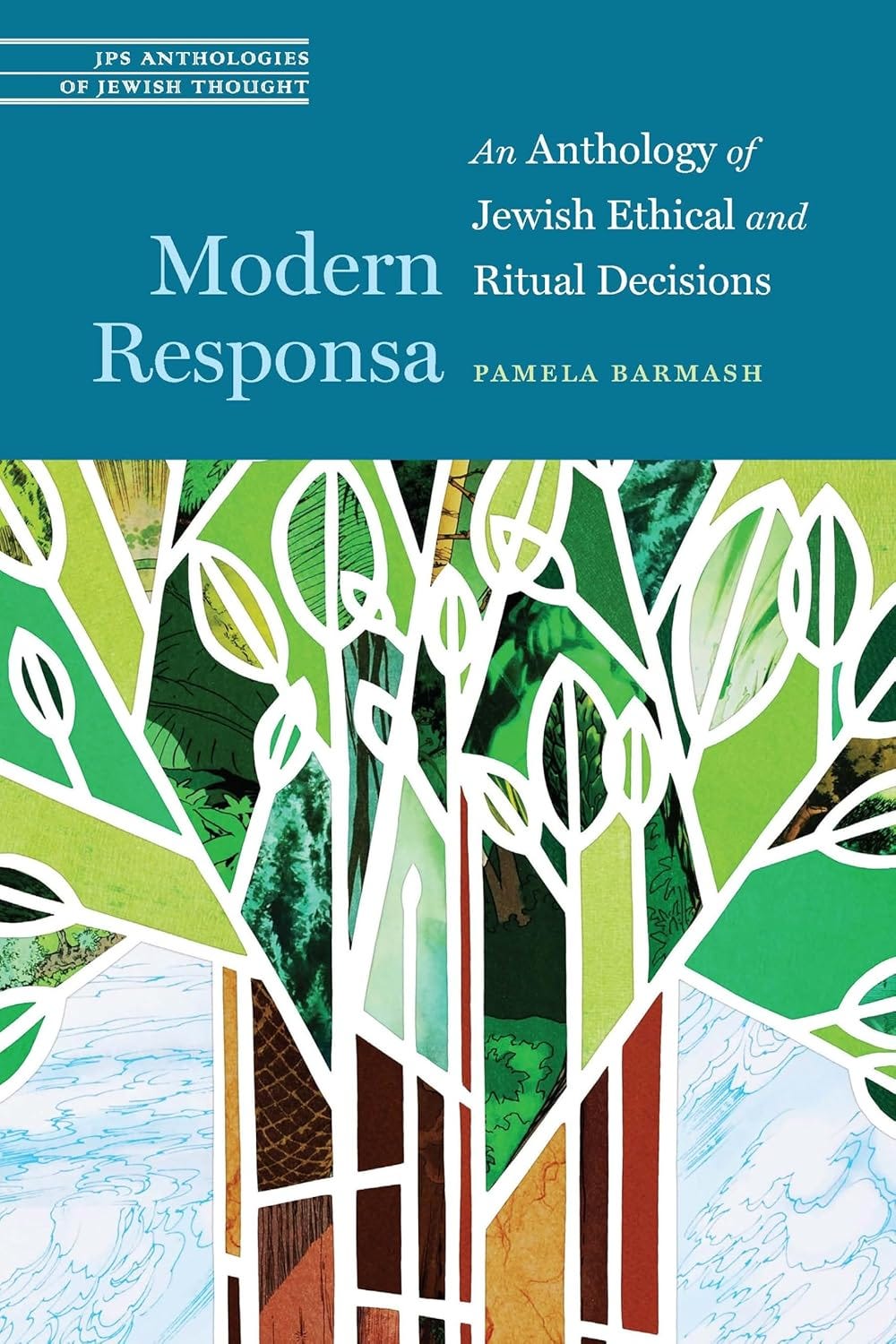
A review of Professor Pamela Barmash's recent anthology.

EDIT: This review was accidentally sent out early. At the current time, fires rage in Los Angeles and all attention to should on helping those in need. The Jewish Federation of Los Angeles (JFEDLA) has created a Wildfire Crisis Relief Fund to support their neighbors affected by this catastrophic event. One hundred percent of gifts go directly to those who need it most.
R. Pamela Barmash is a JTS-ordained rabbi, professor of Hebrew Bible at Washington University in St. Louis, and chair of the Conservative Movement’s Committee for Jewish Law and Standards (CJLS). Her new book, Modern Responsa (JPS, 2024), aims to introduce unfamiliar readers to a representative selection of positions from across the Orthodox, Conservative, and Reform movements. Professor Barmash excludes The Reconstructionist movement from her work because the “Guidelines” they put out “do not cite or analyze the complex and deeply layered textual heritage of Jewish literary tradition and, therefore, are far afield from the genre of responsa.”
Throughout the book, Barmash acknowledges that the Reform and Reconstructionist movements do not view halakhah as obligatory while emphasizing that “both Conservative/Masorti Judaism and the various expressions of Orthodoxy abide by a long-standing commitment to the binding nature of halakhah.” Barmash then goes on to raise several differences across the spectrum:
Conservative and Reform responsa cite academic scholarship. Reform and Conservative responsa, and sometimes Modern Orthodoxy ones, cite scientific publications. The decisions of all the movements generally adduce medical science… Conservative and Reform responsa refer to responsa across the movements, but Orthodox decisions, ranging from modern Orthodox to Ultraorthodox, will never cite responsa from other movements, except perhaps in scorn.
Orthodox readers should immediately raise their eyebrows at such statements. There are, after all, countless examples of thinkers from across the spectrum of Orthodoxy citing a remarkably wide range of academic and scientific sources in both academic articles and responsa literature. The lack of citing their non-Orthodox colleagues is a real phenomenon, but has many counterexamples as well.
It should also be noted that Barmash’s assortment of Orthodox responsa include none from the “Open Orthodox” camp which has advocated for women receiving aliyot, serving as rabbis, and having fulfilling relationships with other women. Barmash’s anthology thus paints a picture in which Orthodoxy is always presented in opposition to the progress championed by other denominations. She includes Orthodox responsa such as the Chatam Sofer’s prohibition on prayer in the vernacular, Rabbi Hershel Schachter “justif[ying] the practice of those refraining from health measures” during the Covid-19 pandemic only to “walk back his justification by noting that a person whose actions may engender others must follow medical guidelines” (a reading of that particular responsum which one colleague of mine commented “borders on intellectually dishonest”), Rabbi Hayyim David Ha-Lavy’s equation of transcendental meditation with idolatry, and Rabbi Moshe Feinstein’s prohibition of celebrating American Thanksgiving. Each of those and more is presented as the Orthodox voice on the particular issue, immediately followed by a more permissive Conservative or Reform responsum. The more progressive positions of these very same thinkers, and even mention of many Orthodox thinkers known for their lenient or otherwise progressive positions, go completely unmentioned. Exceptions to this rule include topics such as combatting classifications of mamzerut and Jewish medical ethics, which were pioneered by Orthodox rabbis and only later discussed by modern denominations.
Barmash also frequently neglects to provide the broader context in which the responsa she includes are put into practice. This is most apparent in her presentation of Conservative responsa, as will be evident below. The brief disclaimer that each religious movement is “diverse within itself” does little to alter the perception her book otherwise sets up.
This essay will examine Barmash’s treatment of three topics: niddah, egalitarian additions to the Amidah prayer, and women’s mitzvah obligations. Though emotionally-charged, those three topics represent the clearest examples of assumed differentiation between Orthodoxy and the other movements. Less charged examples may have been responsa relating to Shabbat and kashrut observance, but such topics were left out of Modern Responsa entirely. Were I to hazard a guess as to why that is, I would assume that sharing the relatively stringent Conservative rulings on Shabbat and Kashrut could potentially alienate Barmash’s readers while the topics included are ones that the liberal movements almost entirely agree on.
A Brief Overview of Conservative Halakhic Decision Making
Halakhic decisions within the Conservative Movement are made by the CJLS, which “sets halakhic policy for Rabbinical Assembly rabbis and for the Conservative movement as a whole” through the following process:
The Committee discusses all questions of Jewish law that are posed by members of the Rabbinical Assembly or arms of the Conservative movement. When a question is placed on the agenda, individual members of the Committee will write teshuvot (responsa) which are discussed by the relevant subcommittees, and are then heard by the Committee, usually at two separate meetings. Papers are approved when a vote is taken with six or more members voting in favor of the paper. Approved teshuvot represent official halakhic positions of the Conservative movement. Rabbis have the authority, though, as marei d'atra, to consider the Committee's positions but make their own decisions as conditions warrant. Members of the Committee can also submit concurring or dissenting opinions that are attached to a decision, but do not carry official status.
With that all having been said, let us examine a selection of the responsa Barmash presents.
Niddah
Barmash only includes one responsum on this subject, written by Yoetzet Halakhah Michal Roness. In her editorial introduction, Barmash writes the following:
The responsum discusses niddah, defined in this volume’s glossary as “the halakhic status of a woman who experiences uterine bleeding not due to trauma” … At the time of niddah, the woman herself is referred to as a niddah; her status is teme’ah, “ritually impure;” and physical contact between husband and wife is prohibited, according to Orthodox halakhah.
Barmash’s implication that niddah is only relevant to Orthodox halakhah is demonstrably false. As recently as 2006, the CJLS accepted several responsa affirming the Conservative Movement’s commitment to observing the laws of niddah as biblically described. All were accepted with little opposition and no dissenting opinions were published then or since.
Egalitarian Additions to the Amidah
In 1990, Rabbi Joel Rembaum proposed including mention of the matriarchs in the Amidah prayer. His responsum passed with nine votes in favor, six against, and four abstentions.
While many Conservative communities follow Rembaum’s responsum, there remains much opposition. Many Conservative synagogues and camps, particularly on the East Coast and in Canada, do not include the matriarchs in their recitations of the Amidah. Rabbi David Golinkin, head decision-maker of Israel’s Masorti Movement, ruled in his own responsum that Rembaum’s proposed method of including the matriarchs “is contrary to halakhah, contrary to our liturgy and contrary to classical theology… and stems from the fact that the idea apparently originated with Jews who are not well-versed in Jewish law and in Hebrew.”
Women and Mitzvot
Barmash next includes her own responsum on women’s obligation in mitzvot. Unlike Rembaum, Barmash’s was overwhelmingly supported with fifteen votes in support, three in opposition, and three abstentions.
In her responsum (but not in Modern Responsa), Barmash added a note:
It is the case that learning to integrate the performance of mitzvot into our daily routines takes time and reflective effort for all of us, both women and men… no one is expected to learn to fulfill every mitzvah all at once.
For many women who grew up in a different atmosphere regarding women’s roles, the call to observe mitzvot heretofore closed to them will be inspiring and deeply spiritual. They will feel ready to fulfill many mitzvot, and they will eagerly learn new habits. But for some women who were raised in a non-egalitarian or not-completely egalitarian atmosphere, it is understandable that they may be hesitant to take on new mitzvot. Learning new mitzvot may be challenging, and some women may find certain mitzvot daunting for a significant span of time. However, it is the calling of our communities, synagogues, schools, and camps to teach men and women to consider themselves equally obligated to fulfill mitzvot and to educate them equally in mitzvot.
The note highlights an important issue that reading Modern Responsa alone would not communicate to readers. Non-egalitarian Conservative Judaism continues to exist. In addition to several Conservative synagogues which remain fully non-egalitarian, many maintain non-egalitarian minyanim or Torah readings which are fairly well-attended. As R. Joshua Heller pointed out in his dissension to Barmash, even within egalitarian Conservative Judaism, a large majority of women do not wear tefillin. In his words, “sensitivity is required that new obligations be imposed at a pace that the community will find relevant and accept” and “it is premature to impose new obligations” on those who otherwise see themselves as observant to the fullest degree. Doing so risks creating a group of sinners where there were previously no issues.
Conclusion
Barmash wrote in her Introduction that Modern Responsa “showcases the vitality of Jewish law in modernity… sheds light on how the halakhic process has evolved in the modern period, highlights the dynamism and creativity of Jewish legal writings on matters significant to modern Jews, and provides insight into the dynamic nature of Judaism and the multidimensionality of Jewish religious experience in modernity.” Unfortunately, if her treatment of Orthodox and Conservative responsa is representative then I would be forced to conclude that the book succeeds only in the most minimal of ways.
Barmash presents a selection of responsa on a selection of issues. In making those selections, she excludes basic facets of Jewish life such as Shabbat and Kashrut observance in favor of hot-button topics which are addressed with insufficient nuance. She presents a picture of Halakhah progressing forward in the Conservative Movement while Orthodoxy slowly attempts to enter modernity in a way that one can only describe as a caricature of both movements. The underlying assumptions behind that image can easily be falsified by reading more responsa literature and by simply looking at how life is lived within both movements. Reading isolated responsa may familiarize readers with that genre of halakhic decision making, but provides little information by which to accurately judge entire denominations. Only engaging with those communities on the ground and seeing how they actually practice their religion can do that. Modern Responsa, then, may be useful as a starting point for those interested in exploring the genre of responsa literature. It would be extremely unfortunate, however, for it to be their only resource on the subject.
******************
If you’ve made it this far, you may think this review is overly critical, and that sharing it is counterproductive to my greater mission of bringing the Jewish people closer together. I myself debated simply deleting the draft file and not sending it out because how little positive I found to say about the work. As the old adage goes, “if you don’t have anything nice to say, don’t say anything.” Yet here we are.
I decided to share this review so I that I could emphasize the following point: Do not judge an entire denomination of Judaism based only on the selected presentation of a single source. If you have questions about the practice of Orthodox (or non-Egalitarian Conservative) Jews, find an Orthodox rabbi to ask about it or visit an Orthodox shul for yourself. We aren’t cavemen and we aren’t hard to get in touch with. We’re always happy to receive well-meaning questions about why we do what we do and are generally happy to engage in thoughtful debate about it if it comes from the right place. I know I am.
Now, more than ever, let’s be in dialogue with one another rather than judging each other based on snapshots.
How many non rabbinic students in the non orthodox segment are even aware, let alone read- those responsa? Also, please do not include any few academics who might be studying those responsa.
The assimilation rate is so high in the non orthodox, they have had to open the doors to patrilineal descent and full embrace of LGBTQ+\~ in order to retain some numbers. These are core beliefs that have had only disastrous effects on their numbers. Indeed, a literacy with those responsa in the laity would surprise me.
Most MO and even OO incorporate those responsa into their weekly sermons…..which points to the other reason those responsa are not known: orthodox go to shul daily and definitely weekly. The vast majority of non orthodox do not.
Please share the rest of your draft files and recycle bin! They make for scintillating reading.