
Orthodox Egalitarianism?
Halakhic Egalitarianism and Orthodox Judaism

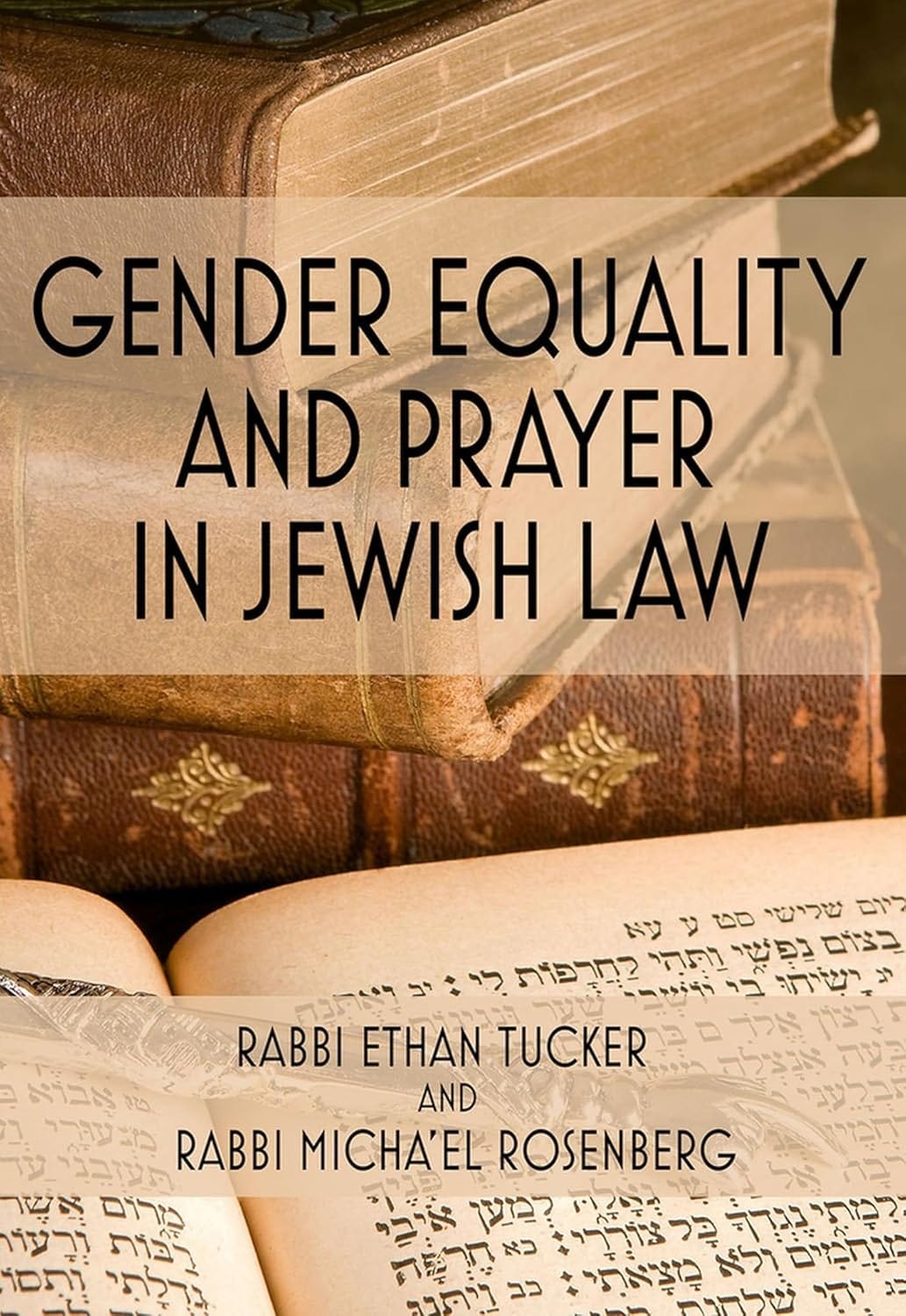
A reader, who happens to be a prominent figure in the Jewish world, noted to me that my last few reviews have referred to Hadar, in passing, as “an explicitly non-Orthodox institution.” They wrote that while Hadar doesn’t fly an Orthodox flag or play by Orthodox political/denominational rules, it’s actually quite difficult to call them non-Orthodox by any coherent definition. They suggested that being Orthodox should “have about as much to do with one's position on gender equality and the halakhic ways to address it as it does with figuring out which eruv you hold by.” I thought about that email for a long time.
Full disclosure from the outset: this essay is more of a think-piece than a book review. That being said, I reviewed Rabbis Ethan Tucker and Michae’el Rosenberg’s Gender Equality and Prayer in Jewish Law (Hadar Press and Ktav Publishers, 2017) when I was still an overzealous university student for my Jews, Gender, and Sexuality class. That paper was actually my first ever book review! I can’t promise that I still stand by everything I wrote, and I certainly can’t promise that the quality is what my current readers are used to, but if you’re interested in seeing what 21-year old me thought of the book before I had the slightest bit of rabbinic training, you can read my original and since-unedited thoughts here. Re-reading the paper, it’s surreal to me how far I’ve come yet how consistent my overall style has been. But I digress.
In a nutshell, Rabbis Tucker and Rosenberg (who both received their ordination from the Israeli Chief Rabbinate) offer two justifications for women to count in the minyan and lead all parts of the prayer service. The first is fairly standard, expanding various arguments for partnership minyanim and the like. Given that partnership minyanim (in which women receive aliyot, read from the Torah, and lead various non-mandatory parts of the service such as pesukei d’zimra and Kabbalat Shabbat) are a phenomenon unique to the Orthodox community, it’s indeed hard to immediately write the first case out of Orthodox discourse given how it’s reliance on the work of Orthodox rabbis and its traditional style of argumentation. I responded to that argument as thoroughly as I could in the review linked above.
Their second case for egalitarianism is what many have come to refer to as the “paradigm shift argument,” which requires a sharper apparent divergence from Orthodox halakhic discourse. Rabbis Tucker and Rosenberg argue that “contemporary women, unlike their female ancestors, are indeed maximally obligated in mitzvot no different from men” rather than merely arguing for minyan eligibility. Their basic case, for which they derive considerable support from positions of Rabbi Yoel Bin-Nun, is as follows:
As is the case with any legal term, one must carefully examine its original context before assuming what it means in a different context. While it is possible to read Hazal’s term נשים as applying across history to all those who are biologically female, it is also possible - particularly when נשים is juxtaposed with the categories of slaves and minors - that this term is intended to refer to adjunct members of society who are dependent on and subservient to their husbands and a larger patriarchal structure for support. Indeed, R. Yoel Bin-Nun has recently been advancing precisely this argument, suggesting that those women in our day and age who understand themselves to be בנות חורין, freed from earlier patriarchal structures, are thus subject to all the traditional ritual obligations of men.
Rabbis Tucker and Rosenberg state that they personally “find this model to be honest and plausible as a halakhic pathway and are drawn to its emphasis on ritual gender equality as a stringency rather than a leniency” but “also acknowledge that this mode if halakhic thinking remains novel and is still being considered and digested in many quarters.” They further acknowledge that different communities will no doubt have different determinations regarding the wisdom of accepting their positions:
Beyond our analysis here, some may argue that counting women in the minyan, though theoretically appropriate today, is too destabilizing to countenance, while others will argue that counting women does not entail any more risks than the benefits it would bring. This argument echoes the dispute we saw above between the rabbis of Amsterdam, who had no objection to women saying kaddish, and the Havvot Yair, who thought such a practice would be disruptive of norms, and the contemporary dispute between R. Mendel Shapiro and R. Daniel Sperber, who see women reading Torah and having aliyot as appropriate, and R. Yehuda Herzl Henkin, who thinks that such a practice will inevitably correlate with a more lax standard of observance and is therefore unwise. We of course have precedent in the halakhic tradition for recognizing that these concerns, as well, are contextual. As we noted previously, R. Ahron Soloveichik permitted women to say Kaddish, precisely because, in his community, to refuse to do so would lead to the weakening of Jewish observance via the abandonment of Orthodox communities by Jewish women searching for synagogues that would allow such a practice. Any assessment of risk and benefit will ultimately be made by each community based on what it experiences on the ground. In communities where distinctions between men and women remain strong generally, tampering with an all-male definition of minyan may weaken the status of communal prayer, and the seriousness with which is it approached. But as we have noted repeatedly, maintaining all-make minyanim in an increasingly gender-equal society has its own risks, including the relegating of communal prayer to a nostalgic activity decoupled from the real data of life. And as R. Bin-Nun points out, such a standard may not only be unwise, but might even be a distortion of the halakhah as it is meant to be applied to a contemporary community that treats men and women in the public realms with equal seriousness and respect.
Back in the book’s introduction, Rabbis Tucker and Rosenberg clarify the extent to which there might be disagreement in applying their arguments:
… we will not systematically address overarching concerns of sexuality that may or may not recommend that women and men in various circumstances be separated or integrated. These issues are centrally important and also notoriously variable across communities and societies. More to the point, they tend to be comprehensive in ways that overwhelm the details of specific rituals and practices. To the extent that the mixing of men and women in a room is improper (whether in the context of sacred spaces or more generally), a broad regime of gender separation is necessary. To the extent that a given community displays no such concerns in mixed-gender settings, those concerns may be irrelevant. To the extent that gender segregation heightens sexual energy in a sacred space, such separation may itself be problematic. To the extent that individuals experience mixed-gender prayer settings as inappropriately sexualized, those individuals have an imperative to avoid such settings. These are all serious questions and concerns but beyond the scope of our analysis While we engage the possibility of mixed gender prayer practices and quorums throughout, we also intend our analysis to be sound for communities where full gender segregation during prayer is the norm and perhaps even the recommended ideal. Most concretely, nothing we say in our analysis takes a position one way or the other on the question of mehitzah, the physical barrier between men and women that has also often functioned as an ideological barrier between different segments of the Jewish community. It is our conviction that it is possible to have separate conversations about gender equality, on the one hand, and gender blindness, on the other.
In other words, as far as Rabbis Tucker and Rosenberg are concerned, it is perfectly coherent to both have a fully egalitarian minyan with a mechitzah. It may even be possible for a community to decide that a minyan made up of only men or only women is alright, but not both. This framing, distinct in many meaningful ways from that of the Conservative Movement, certainly calls into question the degree to which Hadar can be considered “Non-Orthodox.” This is made all the more complicated given that Hadar’s critical mass is made up of otherwise traditionally observant people who would easily fit in at any Modern Orthodox synagogue. Many, in fact, grew up within the Orthodox community but could not bring themselves to find a home in the Conservative movement due to their overarching commitments to halakhah.
In his own review, my teacher Rabbi Aryeh Klapper praises the authors for having “produced a book that is noteworthy for its integrity, accuracy, and clarity” and in which the “formal elements of their arguments are consciously crafted to fall within traditional and contemporary Orthodox halakhic parameters.” This offers “a valuable public service by clearing away the claim that halakhic change to the intersection of gender and prayer is theoretically impossible.” In other words, Rabbis Tucker and Rosenberg have, for the first time in Jewish history, offered an Orthodox (or at least Orthodox-friendly) argument for full egalitarianism within a prayer context.
Rabbi Klapper, however, notes that his “hard-earned and well-deserved praise does not mean that the book ought to succeed in directly affecting the davening practices of halakhic communities, nor that it successfully justifies the gender-identical practices of current prayer communities that otherwise follow the halakhot of prayer.” The reason for is that is because, in Rabbi Klapper’s words, “where there is inadequate halakhistic will, there is no halakhic way. This is true whether or not one believes that there ought to be such will and way. The key questions are what constitutes adequate halakhistic will, and what—beyond intellectual plausibility—is necessary for an argument to gain authority.” The answer to the latter question is challenging in this case, given that the book was written to justify practices that both authors were already engaging in. As Rabbi Klapper, writes,
The Halakhic system sets up different standards for evaluating halakhic arguments, depending on their relationship to existing practice. Arguments that support an idiosyncratic practice of a community that generally accepts conventional halakhic authority may need only meet the standard of limmud zekhut, which can hover around bare plausibility. Arguments that seek to legitimate the practice of a community that rejects conventional halakhic authority, or halakhic authority altogether, may need to be utterly compelling to overcome concerns such as “strengthening the hands of sinners”. It matters a great deal whether gender-identical prayer practices are evaluated under one rubric or rather the other.
It also matters a great deal that Rabbis Tucker and Rosenberg implemented their practices before developing the specific arguments in their book, and that they will continue to follow those practices regardless of the acceptance or rejection of those arguments by other halakhists. It seems reasonable to say that those who are not open to halakhic persuasion cannot lend personal authority to their halakhic arguments; rather, they cannot be given personal halakhic authority, at least with regard to those specific issues, until after their arguments are accepted.
Rabbi Klapper also argues that “arguments for radical sociological change must meet a higher standard than arguments for minor sociological change” and that “arguments for assimilating the practices or values of a nonhalakhic or failed halakhic community must meet a higher standard than arguments for the legitimacy of practices indigenous to a halakhically observant community.” For all of these reasons, Rabbi Klapper suggests, the mainstream Orthodox community has little reason to the arguments of Rabbis Tucker and Rosenberg even though their Hadar community is otherwise observant.
However, Rabbi Klapper further notes that halakhah is generally open to change over time and that today’s non-acceptance of egalitarianism need not preclude such acceptance in the future:
Practical halakhah is responsive to both social change and intellectual creativity, and in general it is unwise to make absolute predictions about its course. There is no question that many men and women who are absolutely faithful to halakhah as-it-is would prefer that it be different. The most anyone can properly say is that he or she cannot imagine circumstances in which this or that practice would become halakhically legitimate, and that, as he or she now understands the issue, any community adopting such a practice now or in the future would be in violation of halakhah.
But neither God nor Torah is bound by our present imaginations, let alone by the imaginations of specific scholars. The gates of halakhic debate close rarely, if ever—and, ideally, never.
It is now worthwhile to reflect on how things have changed in the almost-decade since Gender Equality and Prayer in Jewish Law was published. Hadar has continued to spread throughout the United States and Israel and, as we have seen, Orthodox-identifying institutions have been happy to include their positions in official publications on relevant topics. Given all of this, my tentative conclusion is that Hadar ought to be considered at least as Orthodox as the Orthodox-identifying institutions that happily platform their positions. At the very least, they ought to be considered flanks of the same fleet.
This tentative conclusion leads to at least two possible outcomes. On the one hand, it may inspire a doubling-down on the identity politics which have already significantly divided Orthodoxy. Critics of such inclusion may well argue that some form of gender segregation ought to become the fourth practical sign of Orthodoxy alongside Shabbat, Kashrut, and Niddah. The questions then become where the cutoff point is and how to determine who remains when lines blur. Those who take this position would conclude that if Hadar is as Orthodox as the institutions that accept them, then those accepting institutions simply aren’t Orthodox. While this argument has already largely been made, those organizations and their growing constituencies continue to use the Orthodox label, causing significant category confusion to the incredible chagrin of those who would write them out.
A second option, which I’m admittedly sympathetic to, is to admit that "Orthodoxy” is a largely meaningless descriptor that no longer says anything meaningful about the beliefs one holds or the practices one engages in. This forces a more nuanced conversation about how one’s ideology and actions fit within halakhah rather than particular denominational categories. If something is permitted, it is permitted. If something is forbidden, it is forbidden. If something is a matter of debate, that should be acknowledged and cases for its permission or prohibition should be openly debated. Some communities will permit it while others will prohibit it. If one’s practices or beliefs are deemed unacceptable by their community, they either accept that or relocate to a community that welcomes them. This option is, of course, deeply complicated, but is largely how the Jewish world operated prior to modernity and is still how much of the Sefardic community operates. In this framework, acceptance would be measured by commitment to Torah and Halakhah rather than to a denominational identity that means something different to all who use it.
Regardless of which way things go, it is hard to argue against the continued encroachment of gender egalitarianism within Orthodox-identifying spaces. Time will tell whether “Orthodox Egalitarianism” ultimately evolves from oxymoron to reality. In the meantime, let’s celebrate how far halakhic discourse has come. The fact that these conversations are had, even if the innovations are rejected, is a good thing.
I think that your second potential conclusion has an inherent flaw: if we accept R' Klapper's quote, that the authors had a conviction and moulded their arguments and sources to back it up, rather than looking at the sources and drawing conclusions therefrom, should invalidate the premise, when coming from them.
Yes, this kind of reasoning does exist within the Torah tradition and is often an acceptable methodology to certain constituencies, but it is inappropriate and unbecoming of Torah scholarship and Jewish observance. Just because I can find a heter to do x doesn't mean I should, when it has no impact on lechatchila levels of observance. A post-hoc justification, as RR Tucker and Rosenberg admit in their hakdomoh, only works in a post-hoc (bedi'eved) case and should not be relied upon to make decisions for a baseline. [Comment posted also on your Facebook post of this article]
One can easily rephrase this as
"The fact that these conversations are had, because the innovations are rejected, is a good thing."
I am sympathetic to gender equality. That said, I think one needs a Sanhedrin of some sort to legitimize it. Otherwise the whole Halacha system goes down the drain.
See what R Maroof writes here:
https://vesomsechel.blogspot.com/2017/03/letter-to-my-daughter-thoughts-on.html
Quoted in my post here:
https://daastorah.substack.com/p/is-the-torah-divine-298