Quantum Theology 101

If I had a nickel for every book I've read in the past year that uses concepts from Quantum Mechanics to support Jewish theology, I'd have two nickels… which isn't a lot, but it's weird that it happened twice. Then again, if the project of theology is meant to integrate contemporary science instead of ignoring it, it makes perfect sense for such works to be put out. The only question is whether or not they are of value to laypeople.
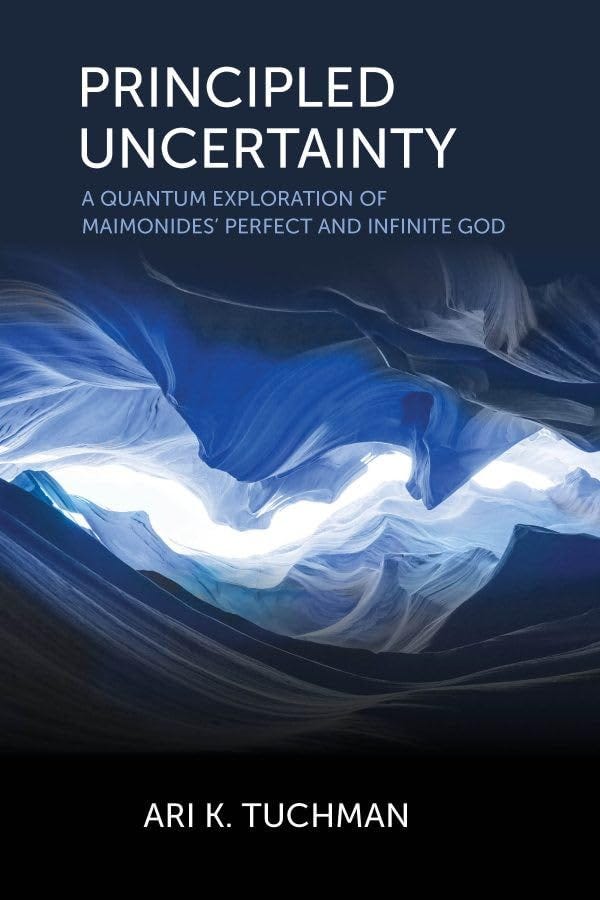
Ari K. Tuchman is an atomic physicist and entrepreneur who studied and worked on precision measurement with quantum states at Yale and Stanford. His recent book, Principled Uncertainty: A Quantum Exploration of Maimonides' Perfect and Infinite God (Kodesh Press, 2023), is an attempt to "advocate for the need to leverage scientific knowledge in pursuit of theology." Of course, science and theology have been notoriously hard to integrate over the years. As Tuchman notes;
When relegated to the polarities of proof or threat, or reduced to choosing between a caricatured defender or prosecutor of the faith, science will always fall short in filling the voids of uncertainty that religion exposes. Similarly, religion is not capable of providing evidence to explain fundamental limitations in understanding scientific observations. This frustration with lack of convergence has led to executions and excommunications, a steady stream of scientific Nobel laureates professing atheism and some religious philosophers demanding the abandonment of any search for truth from science.
On the other hand, relegating science and religion to their own spheres of influence alone in which "science is left to pursue an empirical study of the universe based on observational evidence, and religion remains focused on understanding life's meaning based on belief in God" causes the pursuit of Divine truths itself to suffer since "the tools at the theologian's disposal are too few and insufficient for any to be discarded. Pursuit towards an understanding of God should leverage every method of human discovery and every artistic metaphor that creative thinking can invent."
The challenge that this leads to, however, is that allowing science to inform theology in a significant way turns theological assumptions falsifiable. If one allows science to prove God's existence, updated understandings of science are equally capable of disproving it (I have written about the dangers and opportunity that such a move presents here). For this reason, Rabbi Jonathan Sacks concluded in his book, The Great Partnership: Science, Religion, and the Search for Meaning, that "science gives us a sense of wonder. It does not disclose the source and origin of that wonder… contemplation of the natural universe is an intimation, no more and no less, of the presence of a vast intelligence at work in the universe."
Tuchman takes a similar approach to that of Rabbi Sacks, writing that "science is not designed to provide proof or refutation of God's existence. However, scientific understanding can provide a metaphorical framework for pursuing a personal God once faith is already established." In other words, faith itself is a separate sphere from science, but once one already has faith, it is ideal for it to be "rational, defined by the ability to maintain both logical self-consistency and scientific compatibility." Principled Uncertainty, then, does not seek to create converts as much as it seeks to defend the commitment of the already faithful. As such, it is finds itself the most recent addition to the expanding genre of contemporary Jewish apologetics alongside Samuel Lebens’ Guide for the Jewish Undecided (reviewed by me here) and Yehuda Gellman’s The People, the Torah, the God: A Neo Traditional Jewish Theology (review forthcoming).
Such an approach is ideal for what Tuchman calls the rational believer, who
does not accept explicit contradictions that threaten her sense of logic and scientific knowledge of the world. However, she likewise is not looking to dismiss the divine from her daily life nor eradicate its presence from her understanding of spiritual cannon. She is rational in that she does not dismiss what she knows to be scientifically or logically true in favor of religious dogma. Rather, she strives to apply her knowledge of the world to better understand what is religiously expected of her. Her scientific knowledge initially impacts her actions and her religious scholarship, but ultimately is most critical in how it can influence her beliefs and deepen her relationship with God."
For this rational believer, scientific insight can a) "assist in her functional practice and adherence to the commandments;" b) provide her "with novel interpretations of esoteric passages in the Bible [and] explain aspects of Biblical miracles by leveraging natural phenomena;" and c) assist in "fostering a sense of awe and aiding in pursuit of understanding the Divine."
Based on his field of expertise, Tuchman then argues that "the facts that quantum mechanics have uncovered about how our universe operates can be illuminating in providing analogies to help in pursuit of God." As such, his book is dedicated to "learning from scientific examples, with an emphasis on extracting detailed analogies from quantum mechanics that are intended to help pursue an understanding of God." His confidence in such an endeavor is based on the fact that positing a quantum universe itself comes with religious undertones:
While religion postulates a deeper reality hidden from human perception, quantum mechanics posits a description of reality that cannot be directly observed (e.g. the wavefunction in the Copenhagen interpretation). Religion often advocates for a Divine presence that can observe and interact with this hidden world, and quantum mechanics theorizes an "Observer," responsible for influencing the trajectories of all particles. While foundational interpretations of quantum mechanics do not require this Observer to be conscious, the Observer is nevertheless responsible for the physical world that humanity experiences - blurring the line between underlying quantum states and their collapse into classical observables. Scientifically, this observational role need not be random nor unconscious, but could be intentional, which would then provide the possibility for religious chords. The semantic distance to render such an intentional "Observer" - who impacts the entire universe and causes particles to choose trajectories - coterminous with "God" is vanishingly small.
While this may be starting to sound pseudoscientific, many respected physicists acknowledge the possibility - and potential benefit - of such a move. Andrei Linde, for example, has written that “we cannot rule out the possibility that carefully avoiding the concept of consciousness in quantum cosmology may lead to an artificial narrowing of our outlook.” More recently, Carlo Rovelli has proposed that relationalism (the way in which simple and complex physical systems manifest themselves to other simple and complex physical systems) “can be seen as a very mild form of panpsychism” - which argues that consciousness in some sense permeates reality. From a different angle, Marina Cortes, Lee Smolin, and Clelia Verde have argued that foundational problems in quantum theory, the problem of quantum gravity, the role of qualia and conscious awareness in nature, and the nature of time itself all find greater clarity in assuming that conscious experience is fundamental to physics.
Sean Caroll, though, notes that “any discussion of mental aspects of ontology must specify one of two alternatives: changing the known laws of physics, or positing that these aspects exert no causal influence over physical behavior.” Tuchman’s theology is a Maimonidean one which understands God to be Perfect, Omnipotent, and Infinite. For the book to be compelling, then, he must demonstrate how such a God interacts with the laws of physics. He does so by first laying out four principles about miracles that any attempted scientific explanation must be consistent with:
One is permitted to request miracles from God that can be understood within the parameters of natural law.
Miracles are extremely rare.
Miracles are intrinsic to and do not change the fundamental laws of physics.
Miracles are the will of God, expressing His direct involvement with humanity and the physical world.
Tuchman then suggests the following mechanism for such miracles:
a quantum mechanical description of reality includes superpositions of states, which normally evolve due to environmentally induced wavefunction collapse and decoherence. Therefore, the most likely states within the superposition are the ones usually experienced in the physical world… However, some of the states within the superposition have extremely small but not-zero probabilities. These unlikely states can be amplified with the correct form of observation (also known as measurement). This collapse and decoherence due to an intentional measurement can be analogously equated with Divine observation.
In other words, God’s ability to see into the quantum mechanical blueprint of reality would allow Him to have an impact on certain things that happen in the world. However, since quantum mechanics is based on probability, there would never be an absolute guarantee of the miracle happening. According to Tuchman, “God could induce sequential measurements to an exact time of His choosing to render a favorable outcome; the probability of success for the observation to affect a miracle could asymptotically approach 100%, but it would not be exactly 100%. Thus, it is possible, albeit improbable, that even the prayers of the most righteous could appear to have gone unanswered.” Tuchman then goes on to explain how quantum mechanics can inform other Divine characteristics.
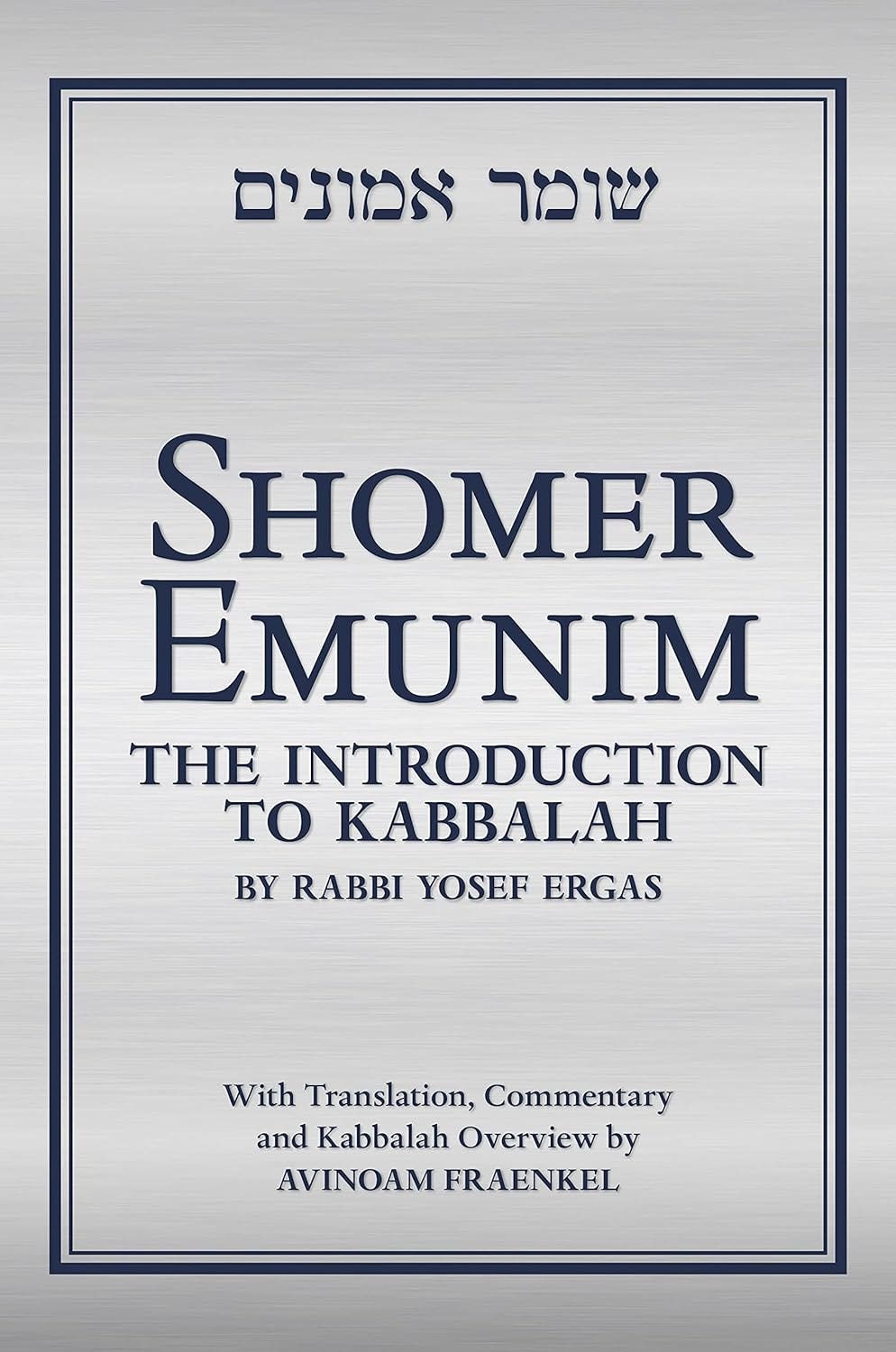
Interestingly, Tuchman is not the only person to recently attempt to align Jewish theology with Quantum mechanics. Avinoam Fraenkel does the same in service of Kabbalah with his translation and commentary of R. Yosef Ergas’ Shomer Emunim (Urim, 2021). Fraenkel writes that
The Kabbalistic understanding of the very fabric of nature and of the entire universe is that everything that exists at every world level is a Partzuf [a “face” of reality] in its own right that is nested within every increasing larger Partzufim. As every lower Partzuf goes through the process of integration and reorganization of its parts into a unified collective that, in turn, then integrates with its corresponding higher Partzuf, intellect and insight emerge that were not previously evident or predictable. Therefore, from the Kabbalistic perspective, emergence is the ultimate property that the development and growth of all collectives in general existence should exhibit at every higher level of collective existence, including all levels within the natural physical world. nevertheless, at the same time, the sum of all parts of any whole collective is identical to that whole collective.
This view of reality being made up of multiple layers of experience going from Hashem to humanity and beyond becomes easier to justify through understanding how Quantum mechanics relate to its Newtonian counterpart. Newtonian mechanics describe the world as human beings see and interact with it while Quantum mechanics describe the world on the scale of atoms and particles. Fraenkel then points out that no correspondence theory which tries to show how Newtonian mechanics answer to Quantum mechanics has every been mathematically proven. Therefore, each should be seen as accurate descriptions of their respective layer of reality. Such an understanding leads to the natural conclusion that
the fundamental laws that emerge at every relatively higher level of organizational collective are, at least to a high degree, insensitive to the fundamental laws that apply to every lower level. This means that, under normal circumstances, the ability for beings to optimize their interaction at their level of existence requires a knowledge of the laws that specifically apply to that level. However, while knowledge of the lower level may be extremely helpful to more fully understand various behaviors at the higher level, that knowledge will not directly predict or dictate the way the higher level must function.
The disagreements between Tuchman and Fraenkel should not be minimized. While the former relies on a correspondence between Quantum and Newtonian understandings, the latter does not. Ultimately, though, Tuchman uses quantum mechanics to justify a Maimonidean, rationalist, theology while Fraenkel invokes the same picture to justify a mystical, Kabbalistic one. One who enjoys being tongue in cheek may use this as a support for the argument that Maimonides was a closeted Kabbalist, but I would prefer to go with the argument of my teacher, Rabbi Dr. Sam Lebens: rather than drawing a hard and fast line between mysticism and rationalism, we should draw the line between good and bad philosophy (or, in this case, good and bad scientific understandings). If a better understanding of Quantum Mechanics can help both mystics and rationalists better relate to the world its Creator, then that is a clear victory for theology as a whole. Especially when they are unpacked in ways for anyone of any background to benefit. In Tuchman’s words,
Ultimately, faith is a choice and not an exercise in scientific proof. But it does not need to be an irrational choice. There is no scientific alternative that can answer fundamental questions of origin and meaning. Therefore, it is neither more or less rational to believe in God than it is to insist that God does not exist. There is no incontrovertible scientific evidence in either direction… The Kotzker Rebbe, R. Menachem Mendel of Kotzk (1787-1857), famously stated that God resides where you invite Him in. Quantum mechanics provides the framework for a rational invitation.