
Two Modern Orthodox Myths

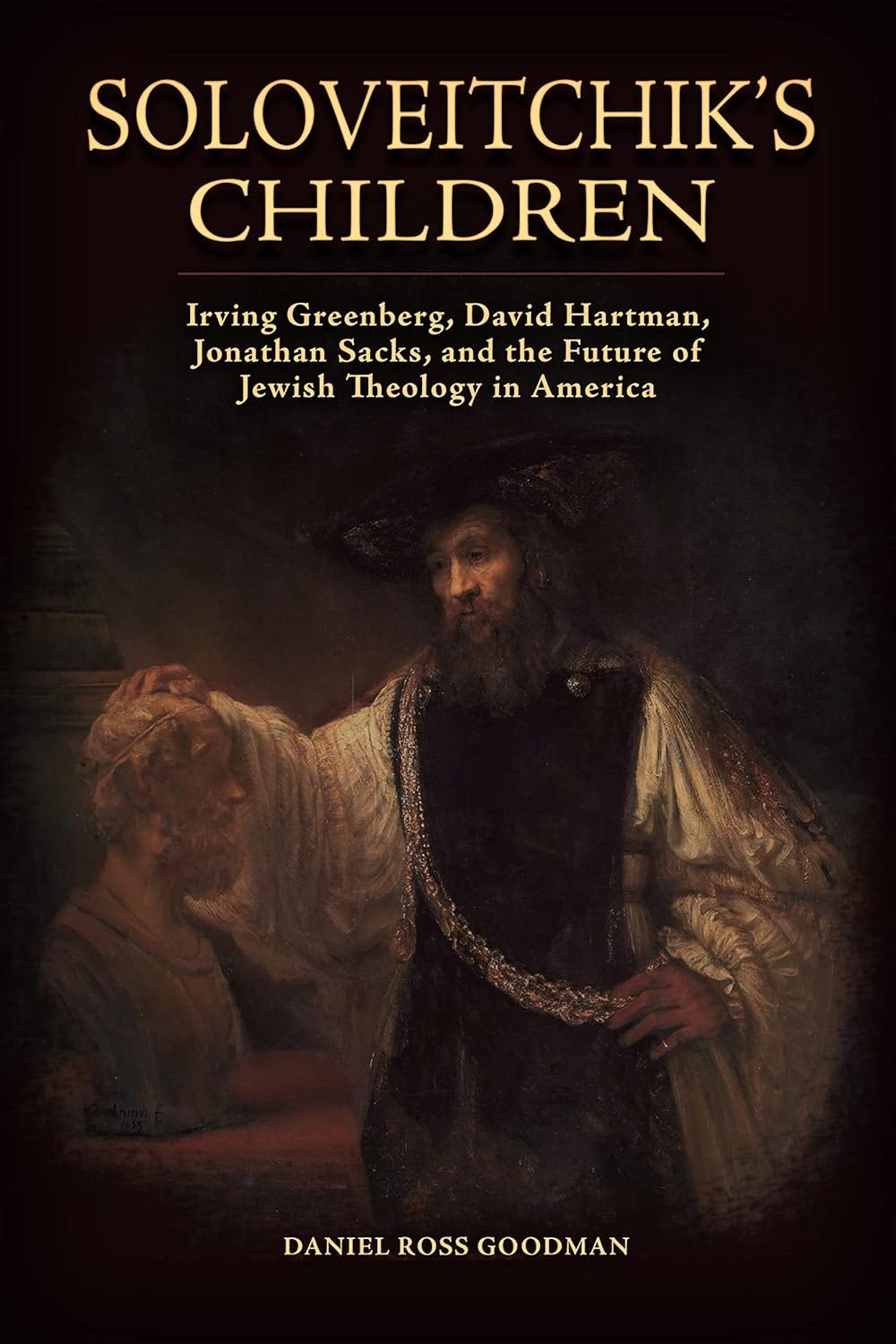
This month, I was privileged to release two lengthy essays about Rav Soloveitchik’s relationship with his students. My review of Rabbi Dr. Daniel Ross Goodman’s Soloveitchik’s Children: Irving Greenberg, David Hartman, Jonathan Sacks and the Future of Jewish Theology in America (University of Alabama Press, 2023) was published in the most recent issue of Hakirah: The Flatbush Journal of Jewish Law and Thought while my essay I titled “A Parting of Ways,” examining the specific relationship between Rav Soloveitchik and Rabbi Dr. David Hartman, was published yesterday on Torah Musings.
In my opinion, Soloveitchik’s Children is the best book out there on the thought of Rabbis Greenberg, Hartman, and Sacks. Goodman demonstrates a masterful command of their works and a deep commitment to spreading their visions of Judaism to wider audiences. As a book about the three of them, and how Rav Soloveitchik impacted them, there is much to gain and I highly recommend it.
Having said that, my review is extremely critical because I believe (and spent nearly 20 pages attempting to demonstrate) that Goodman's thesis ultimately fails (with the exception of one thinker under discussion… likely not the one you think!).
In the case of Hartman, one can hardly blame Goodman for this. Hartman was in Rav Soloveitchik’s shiur at YU and the Rav wrote his letter of recommendation to study philosophy at Fordham. At some point, Hartman distanced himself not only from Soloveitchik but from the traditional interpretation of Halakhah that Soloveitchik championed, but that point is typically assumed to have occurred quite late in Hartman’s life. Goodman’s assumptions are consistent with the common narrative:
Hartman offered these criticisms of Soloveitchik in his eighties; thirty-plus years prior to these remarks, he had praised Soloveitchik precisely for not being an apologist… Even into his seventies, Hartman had still been defending Soloveitchik against charges of apologia… Instead of portraying Soloveitchik – as he later would in The God Who Hates Lies – as a clever apologist, in Love and Terror, his book-length study of Soloveitchik’s theology, Hartman paints Soloveitchik as a “midrashic artist” … Why Hartman’s views of his teacher had become considerably more critical as he neared the end of his life is perplexing.
In my article on Torah Musings, I attempt to demonstrate that Hartman’s transition represents a sustained and consistent departure over time beginning far earlier in Hartman’s life than most assume as opposed to a perplexing about-face later in life.
Hartman’s most famous break from Orthodox Halakhah is detailed in his 2011 book, The God Who Hates Lies, which was published when he was 80 years old. He explicitly allowed his moral intuition to trump all Halakhic sources and precedent in order to permit a Kohen to marry a divorcee. Hartman described the case as coming before him when he was “a young congregational rabbi… in Montreal” and as an experience “especially vivid to me, even some fifty years later” while writing The God Who Hates Lies. Fifty years prior to writing the book would place the situation around 1961 – the first year of Hartman’s rabbinate at Congregation TBDJ (“The Bailey Shul”) in the Cote St. Luc suburb of Montreal. If his assessment of the timing were accurate, that would place the initial moment of his break at the age of 30.
Of course, it’s unrealistic to base anything off of this since Hartman himself doesn’t give an exact date. A much closer approximation can be established from his 1978 volume, Joy and Responsibility (the first volume published by the Shalom Hartman Institute). In the book’s introduction, Hartman (who made Aliyah in 1971), places his departure from Soloveitchik’s way of thinking in “the aftermath of the victory of the Six Day War:”
I felt compelled to come to Israel to find a way of appropriating [sic] the reality of the Jewish State. After visiting Israel, I went enthusiastically to my Rebbe (teacher), Rabbi J. B. Soloveitchik, with the request: “Proclaim a religious festival; proclaim God’s presence in history! Must God only be revealed in stories? Can we not celebrate the living God of our directly-felt redemption?”
Soloveitchik responded by referring to a talmudic passage which says that the festival of Hanukah which celebrates the Maccabean victory and the miracle of light was not proclaimed immediately after the wondrous events but, rather, only a year later. Pointing out the significance of “a year later,” Soloveitchik counseled me to wait and not to react in the heat of excitement.
His sobriety and restraint revealed to me, at that moment, the chasm that separated us. I passionately wished to enter history – whereas he chose to be satisfied with history mediated via Halakhah.
Assuming that conversation took place in 1967, Hartman would have been only 36 years old. Later in the same book, Hartman wrote that the “greatness of halakhic man was his commitment to law, which in effect made him immune to history. The tragedy of halakhic man, however, is that Halakhah failed to respond adequately when the Jewish people consciously re-entered history.”
From there, his attempts to forge a different Halakhic path from Soloveitchik can be naturally traced in his writings, including his 1985 magnum opus, A Living Covenant which many seem to incorrectly assume being in line with Soloveitchik. In it, Hartman wrote that Soloveitchik’s “religious anthropology gives support to the claim that Judaism must create obedient personalities who give total allegiance to authority without allowing any independent moral or rational considerations to enter into their evaluation of their obligation to the norms and theological claims of the halakhah.” He went on to argue that “the surrender of human rationality and the sacrifice of one’s human ethical sense are not required by Judaic faith.”
We thus have four plausible options in placing Hartman’s break from Soloveitchik’s approach: the early days of his Montreal rabbinate (when he was 30); the immediate aftermath of the Six-Day War (when he was 36); the publication of Joy and Responsibility (when he was 47); or the publication of A Living Covenant (when he was 54). All three of these options place the break far earlier than most assume and demonstrate that the idea of Hartman being a loyal student of Soloveitchik’s approach until his abrupt break as an octogenarian in 2011 to be a well-told myth rather than grounded in reality.
I also took significant issue with Rabbi Dr. Goodman's choice to split the Rav's "philosophical" vs "halakhic-talmudic" disciples when a core part of the Soloveitchikian epistemology involves learning philosophy out of Halakhah. That move allowed Goodman to bracket off thinkers like Rabbis Hershel Schachter, Aharon Lichtenstein, Norman Lamm, Mordechai Willig, Hershel Reichman, and Meyer Twersky from consideration as “legitimate philosophical disciples” of Soloveitchik.
This is a particularly interesting move on Goodman’s part regarding Rabbis Lamm and Lichtenstein. Lamm was the only student to ever write his doctoral dissertation (certainly a philosophical pursuit) under Soloveitchik.
Regarding Rav Lichtenstein, Rabbi Yitz Greenberg himself was under the impression (and quoted by Goodman as saying) that Rav Aharon only became the Rav’s best student by being “able to accommodate himself into what Soloveitchik wanted in an ideal student.”
This admission — that Soloveitchik had an ideal model of student which some who attended his lectures met while others did not — turns a common understanding of Rav Soloveitchik on its head if it’s true. While most understand Soloveitchik as emphasizing that his students were welcome to move in whatever directions they wanted, Goodman (presumably unintentionally) reveals this to be a myth.
Goodman explicitly writes about how Soloveitchik “was not pleased when his closest students expressed opinions that were not those of their teacher” and even proposes that it was because Greenberg “had never been among Soloveitchik’s primary students in his primary area of intellectual and spiritual pursuit—his Talmud lectures,” that Greenberg had more flexibility than Soloveitchik’s “closer” students. Recalling that Soloveitchik saw religious philosophy and talmudic study/halakhic analysis as one and the same thus leads to an unfortunate indictment of the idea that Soloveitchik considered students who moved too far away from him to be disciples in good standing.
Goodman further notes that those “who were in his Gemara shiurim were considered Soloveitchik’s closest students, and Soloveitchik kept them on a tighter leash ‘hashkafically’ (philosophically)” than others. Hartman did attend Soloveitchik’s talmud lectures, but Greenberg believed that he found similar flexibility precisely because he “was not one of Soloveitchik’s closest students.” In other words, Greenberg and Hartman both found that Soloveitchik was “extremely tolerant of them, listened to them respectfully, told them that perhaps they were going a little too far, but never belittled them and never denounced them” despite their “moving further, philosophically and theologically, than Soloveitchik was comfortable with” precisely because Soloveitchik did not consider them to be close students of his and therefore saw no reason to take responsibility for their positions. Had they been closer students of Soloveitchik, it is very possible that the Rav would have more directly dissuaded them from moving in various directions hashkafically.
If Goodman’s work is to be taken seriously, it paints a perhaps uncomfortable picture that the stories our community tells itself about the nature of Rav Soloveitchik’s radically tolerant relationship with his students and the degree of intellectual freedom he permitted his closest ones may also be merely a well-told myth.
Responding to my essay on Torah Musings, a user called ‘Kohelet’ posted the following comment:
Excellent analysis. On this topic of Hartman’s departure from the traditions of his mentor, Soloveichik, it is worth noting the oft quoted story of Hartman’s concern following Soloveichik’s encouragement for Hartman to work on a doctorate in philosophy at Fordham University:
“But I may go astray in such a permissive place,” the young scholar worried.
“Planes crash,” Soloveichik said, “but we take them to get where we need to go.”
The epilogue to this story is that decades later Hartman and Soloveichik attended a rabbinical gathering, and Hartman wished to have an audience with Soloveichik and reached out to one of Soloveichik’s students telling him: “Rebbe, ‘Duvie’ (as Soloveichik called Hartman) is here to see you).” And Soloveichik declined to speak with him responding: “Duvie, I don’t know of such Duvie.”
When told that Soloveichik would not speak with him, Hartman quipped: “Tell him that the plane crashed!”
In response, Professor Lawrence Kaplan commented the following story on my social media post of the article:
…all I can say is that in the summer of 1981 (that is, when the Rav was 78, late in his Active career) I met with him several times over the summer to review with him my draft translation of Ish Ha-Halakhah. Upon arriving at one of the meetings, Rabbi Hartman was just leaving. After he left, the Rav turned to me and asked me “Do you know him?” I answered, “of course I know him.” The Rav then queried. “So, what do you think of him?” I wanted to reply “Who cares what I think of him? Everyone wants to know what you think of him!” Instead I gave an evasive reply that committed me to exactly nothing. “He’s a dynamic speaker. Very controversial.” We both fell silent and I could see the Rav was reflecting. After a few moments he said, — and I have quoted this many times— “He’s a searcher. Could use more discipline. I like him.” Let me add that all the people familiar with Rabbi Hartman to whom I related this have stated that this may be the best concise description and evaluation of Rabbi Hartman on the record and is right on the mark.
It may well be, then, that Rav Soloveitchik’s refusing to meet with Hartman was either another myth or a public demonstration. But continued relationship does not mean continued discipleship. I would hope that many of my former teachers like me, but I’m not sure how many would consider me a disciple in any meaningful sense…
In response to my review of Soloveitchik’s Children, I received an email from someone I greatly respect — a well-known public figure who is considered to be a leader within the most liberal segment of Modern Orthodoxy — telling me that my writing was "shockingly mean and disturbingly unkind," that they wished I "chose a different path" and that they are "not interested in a back and forth... just wanted to express my מחאה and disappointment." They also implied that my penning the review was meant to in some way enhance my standing with the “Right Wing Modern Orthodox” community. (Note: I attempted to clarify things but, consistent with the thought expressed, did not receive any response).
Readers of the review in its published form can determine for themselves if such a characterization is accurate. Even if it is not, I want to publicly share how much I respect Rabbi Dr. Goodman and how thankful I am to him for the opportunity to review his book. There is much I should have done to have ensured that respect and appreciation for his work came across in the review. Even if I don't think his central thesis is correct, it is a remarkable tribute to and continuation of his three central figures. In writing this book, he has certainly succeeded in doing with them what he claims they did with Soloveitchik by continuing their work and sharing their ideas with an audience ready to be inspired by their examples.
I share all of this on Substack in order to get just one message across: There are certain myths that we hold dear about figures in our camp (whichever camp that might be), and we tend to respond very strongly when those myths are challenged. If one suggests that thinkers like Rabbis Jonathan Sacks, Yitz Greenberg, David Hartman, Hershel Schacter, or the like are not “legitimate” disciples of Soloveitchik, their students (who see themselves as grand-students of the Rav) often take it personally.
It is, of course, important to operate within an established mesorah, and the mesorah of the Rav certainly brings with it a certain degree of pedigree. But why is it so hard to admit that mesorot diverge and that certain thinkers (including all three protagonists of Soliveitchik’s Children) have independent legacies that, if anything, stand stronger and taller without being tied down and aligned with one particular thinker who was diametrically opposed to them on key issues?
Why is it that, as opposed to being proud of who our own teachers are, we seem to care more about who their teachers were? At the end of the day, when it comes to our own relationship with the Jewish tradition, that relationship is mediated by our living teachers and mentors who undoubtably see the world through their own unique lenses.
Just some food for thought.
Except that in the case of R Jonathan Sacks, he never studied under Rabbi Joseph B. Soloveitchik. R Sacks calls him an influence, alongside the last Lubavitcher Rebbe. We only know them meeting once, when R Sacks was in Cambridge and took a trip to the US to meet a number of famous rabbis.
Being influenced by R Soloveitchik's thought does not creat the rebbe-talmid relationship that is assumed when discussing how the student embraced and how he diverged from the mentor.
EDIT:
I just found a eulogy R Sacks wrote, in which he calls that his first meeting with R Soloveitchik. So there much have been others. But he also outright says he wasn't a student.
https://media.rabbisacks.org/20211010200426/Issue-36-Sept-1993-Hesped-in-honour-of-Rav-Yosef-Soloveitchik.pdf
Well written.
The Rav was generally a tolerant man (ok, not so much sometimes in shiur!😀) when dealing with עמך. He was also a shul Rabbi. Not a shul within a yeshiva, but a shul with some very impressively brilliant ba’alei batim (think MIT and Harvard). Those very experiences are what made him tolerant (although that was to be seen outside the classroom).
On a separate note, I would love to see an in depth analysis of the Rav’s relationships with Emanuel Rackmam זצ״ל and Bernard Lander זצ״ל years…….