
Unbinding Orthodoxy

I have a confession to make: Judaism Unbound is my favorite podcast.
I hear some surprise. Why should that be?
Well, I first discovered Judaism Unbound during Covid, at a time when I was questioning much of the theological axioms I held since well before I became Orthodox. The podcast opened my eyes to new ways of thinking about Judaism and helped me articulate why I agreed or disagreed with what I listened to and thus helped me articulate to myself what I actually believed and why I believed it.
As I continued listening to the podcast regularly, I found that there were few things I enjoyed more than having my assumptions about what Judaism had to look like questioned from week to week. The experience made my religious experience feel constantly fresh and everchanging in a way that kept me excited and eager to expose myself to more diverse approaches.
Of course, that sort of thing isn’t for everyone. But it was certainly for me and I’m profoundly grateful to have incorporated listening to Judaism Unbound into my erev-Shabbat routine.
Now onto the book.
From the beginning, we meant for Judaism Unbound to empower people to learn what they want to know and experiment in their own Judaism. We wanted it to be an invitation to be part of a community of people grappling with the future of Judaism and their place in it. We always believed that our listeners – and now our readers – didn’t need to or want to be told what to think. Now, with this volume, we are literally putting the future of Judaism in your hands. (4)
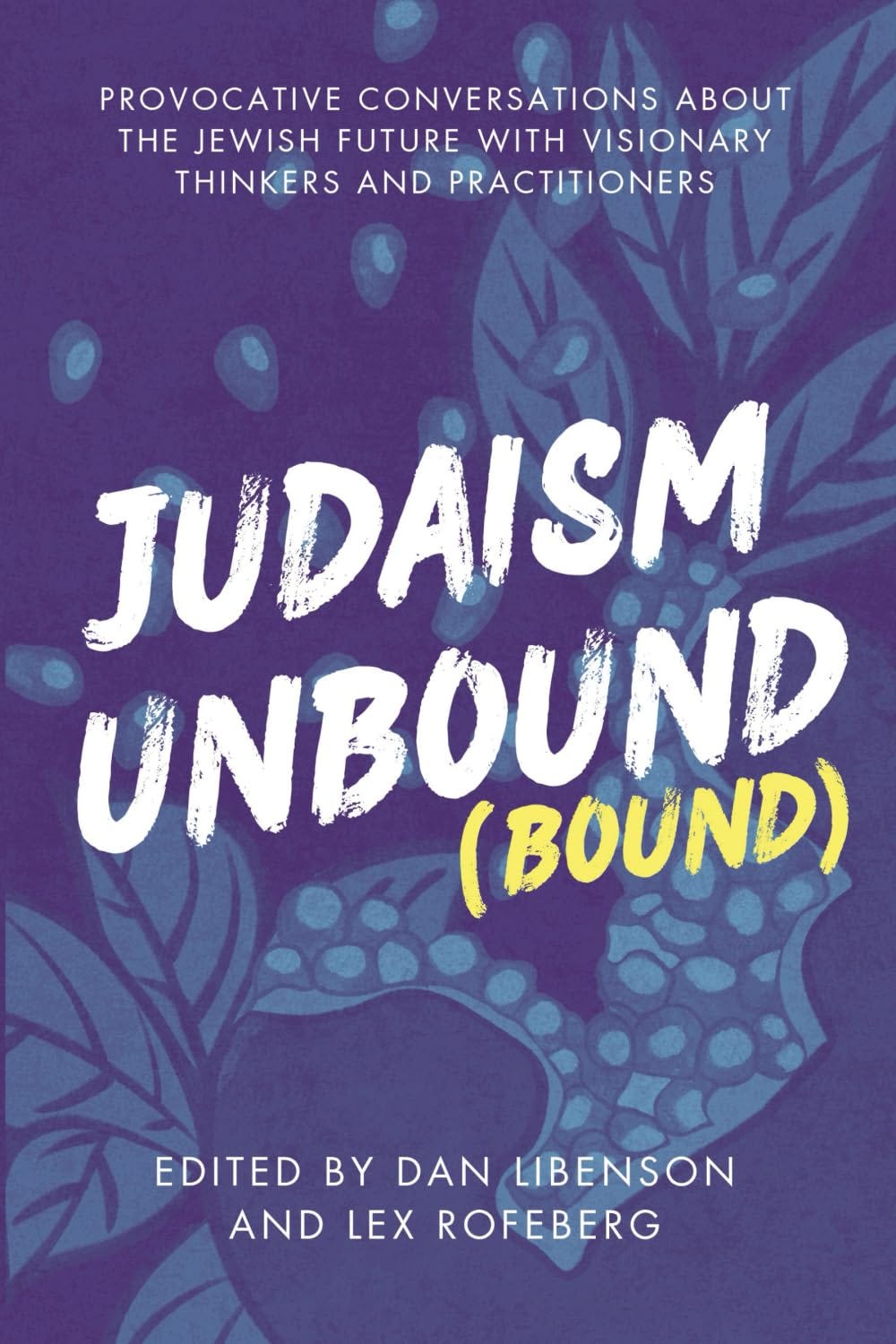
With an introduction like that, one might wonder what place a review of Judaism Unbound (Bound): Provocative Conversations about the Jewish Future with Visionary Thinkers and Practitioners (Ben Yehuda Press, 2025) has by an Orthodox-ordained rabbi. To the extent that the podcast is known at all in our circles, after all, it’s for irreverence towards the traditionalism we try to represent. With a stake in the Jewish future, though, it behooves us to understand how the broader Jewish world thinks. Rather than avoiding these conversations, it is our responsibility to be part of them even (perhaps especially) if it makes us uncomfortable at times.
In a somewhat unorthodox move, befitting such an intentionally unorthodox endeavor, I’ll begin with a look at the last chapter of the book (the only one aside from the introduction that is not a transcript from one of the episodes of Judaism Unbound). It’s an article by Steven Kaplin entitled Podcasting Judaism: Judaism Unbound and the Method of Jewish Tradition. In it, Kaplin proposes that Judaism Unbound be seen as “a digital case study through which to analyze contemporary American Jewish thinking and the methods that inform it” and that former Hillel professionals and Judaism Unbound hosts Dan Libenson (who relatively recently stepped away from the podcast) and Lex Rofeberg “leverage the podcast medium toward the presentation of a vision for American Judaism in the digital age” (334). In doing so, he offers an excellent introduction to the podcast for readers who might be unfamiliar:
American models of religion-skeptical spirituality are particularly relevant to Judaism Unbound: a general discomfort with normative religious leaders and institutions, a strong inclination toward diversity (e.g., racial, sexual), and a willingness to converse with and borrow from a wide variety of religious and religion-adjacent communities are common features of Judaism Unbound episodes. Moreover, American modes of Judaism and Jewish thinking serve as the springboard from which the hosts level their critiques and proposals. The co-hosts frequently describe their frustrations with American Jewish settings, both in Orthodox and liberal Jewish communities, and along with their weekly guests, most of whom are American as well, use the podcast as a think tank for new possibilities for Judaism in the US. Over the years, the podcast has explored un-orthodox (and un-Orthodox) perspectives on a wide range of Jewish themes, including, theology, Israel/Palestine, Jewish texts, gender and sexuality, race, Jewish institutions and communities, and ritual and holiday observance, but each of these topics – even Israel/Palestine – is conducted through the lens of American Jewry. (241)
I’ll briefly note here that one of the things which surprised me about Judaism Unbound (Bound) is that it stayed away from discussing Israel/Palestine and theology — the latter of which was what first got me hooked on the podcast. I can’t imagine that the exclusion was unintentional, given how much thought Judaism Unbound puts into their work and how proud they are of being provocative. On the other hand, inasmuch as a goal of any book is to reach a wide audience, I imagine there had to be some degree of “picking their battles” and prioritizing a diverse but largely neutral cast to introduce readers to within a somewhat unified theme. But I digress.
Kaplin summarizes Libenson’s Ten New Commandments “that might contribute to the creation of new forms of Judaism:”
We [Jews] should stop doing the things that do not work.
In remembering our collective Jewish past, we should elicit help from people who did not grow up Jewish.
We should drive properly for what is left behind.
We should forever study even the things we no longer do.
In order to keep alive the things we no longer do, we should develop practices that help us to remember (e.g.; holidays).
We should give new innovations time to develop without immediate comparisons to already-existing Judaism.
We should “modernize and democratize” the creation of Judaism by encouraging a wide range of people to develop and test individual ideas and practices.
We should recruit non-Jewish friends to help us develop Judaism.
We should be wildly experimental.
We should center artists and innovators as leaders. (345)
The context of those commandments was a thought experiment at the beginning of an episode of Judaism Unbound (link) in which
Dan transports us to a hypothetical conversation happening in the year 30 C.E, in which someone proposes a new vision for the future of Judaism — without the sacrifices that had been the defining feature of Judaism to that point, and having replaced them with prayer — and promptly gets laughed out of the room. Comparing that moment to our own context in American Judaism, Dan proposes ten new “commandments” that would establish (or re-establish, as Dan argues that these commandments constitute the tried-and-true Jewish way of re-imagining Judaism) a process for helping us make some of the hard decisions associated with discarding elements of Judaism that we have inherited and experimenting with new ideas and practices that will be part of the Judaisms of the future. In exploring these issues, Dan and Lex also ask what it would look like to more consciously “archive” and study rituals from the Jewish past that may not continue as part of the lived Jewish experiences of Jews in future generations.
It is not lost on me, and should not be lost on my readers, that some of what they wish to archive are ways in which Judaism is currently practiced throughout the Orthodox world. On the other hand, as Kaplin notes as well, there is something refreshing about this discussion happening explicitly and directly, as opposed to beneath the surface.
Judaism Unbound (Bound) invites readers to take part in this process themselves. In the book’s spirit of encouraging readers to “choose your own adventure” by focusing on what most appeals to them, I’ll share some ideas that I found most thought-provoking.
It starts with a crash — Crash Theory, that is. In Rabbi Benay Lappe’s words, “every master story will ultimately, and inevitably crash… that story will cease to work for you, or will stop answering those basic human questions for you” (4). Such a crash can be responded to in one of three, “and only three” ways:
Option One, which is denying that a crash has occurred and reverting to your master story and hanging on for dear life. Building walls around that master story to make sure that nothing interferes or threatens it again.
Option Two would be accepting that your master story has crashed, completely rejecting that master story, and jumping off into a completely new story.
And Option Three is to accept that the story has crashed, but instead of abandoning the story, you stay in it and retell it and make it better. This is kind of the remix/upgrade/retell approach. (11)
Option Three, Lappe notes, “will be something that would’ve been unrecognizable to those for whom the old story worked before the crash” (23).
An example that the Modern Orthodox world is quite familiar with is the post-holocaust theology of Rabbi Yitz Greenberg, who is also featured in the book:
By becoming totally hidden, by asking people to take human responsibility, God is saying we’re now living in the age of voluntary covenant. People don’t keep it because God is punishing them, or because God imposed it, or because they once accepted it. They’re keeping it voluntarily, because – despite the risks, despite the setbacks – they really believe in the vision and the goal. Does that mean God has no authority? Quite the contrary. The authority is no longer imposed – it’s earned. The authority is no longer automatic – it is chosen by those who follow. (53-54)
Another example featured is Rabbi Irwin Kula, who succeeded Greenberg as president of Clal: The National Center for Learning and Leadership. For Kula,
9/11 changed everything… I had what might be called a spiritual breakdown. And for three months I did not teach, I barely left my apartment, and what really became clear to me – and this is the radical way of saying it, I don’t mean to offend anybody – I had a realization that I would never, ever, teach Judaism again to make better Jews, that I would never, ever, teach Judaism again to strengthen the tribe. There was enough “groupiness” in this world, there was enough tribalism in this world, and that had been a fundamental cause of religion rearing its ugly head in 9/11.
Either Judaism in the next iteration was going to be a wisdom and a practice that could help all human beings flourish – and therefore had to be taught and offered in accessible and usable ways – or I was out of this game. This was either a genuine wisdom and practice that could help anyone flourish, or it was a great run, and it’s time to put this tribal fetish out of business. (60)
Orthodox readers may ask why Kula felt such a strong need to admittedly make CLAL less Jewish of an organization in response to his self-proclaimed spiritual breakdown as opposed to taking the opportunity to “get out of the game” and use his skills in the other contexts like so many Orthodox rabbis do after burning out from their respective positions. Some might see the direction CLAL went in due to his decision as tragic. This is presented in the context of Judaism Unbound, however, as a significant success in divorcing Judaism from the tribalism that is seen by much of the broader Jewish world as baggage rather than beneficial. And it is precisely that difference in response that makes Judaism Unbound, and the voices shared through it, so important for Orthodox/traditionally-minded Jews to engage with.
Returning to Lappe, the “queerest” group of people in a given group tend to crash first, signaling broader institutional turbulence to come. She describes queerness not only by gender or sexuality but representing those with “a profound outsider experience of life” in their community (15). Several conversations are thus dedicated to addressing the place of such people within the Jewish community.
One account particularly poignant to Modern Orthodox readers may be Joy Ladin’s, a trans professor (and chair of the English department) at Yeshiva University’s Stern College for Women until 2021:
But of course, it is different to be there as someone seen as a heterosexual man – highly valued by the culture – versus someone seen as a transgender person, which I think is something that Orthodox culture simply does not have any slots for. For most of my students, they either, I think, see me as other, or they see me as somebody with a serious sexual fetish that I’m trying to drag other people into, or they see me as mentally ill… I think queer cultures also have limitations in their understanding of somebody like me. Religious queer people often feel like, “Well, when I go to a queer conference, some parts of me are understood, and other parts of me are looked down on. In religious contexts, it’s the reverse.” (103)
A timely group to consider as well is intermarried Jews, voiced in the book by Paul Golin of the Society for Humanistic Judaism. For Golin, “intermarriage as a trend is something that can open doorways into a lot of complicated and nuanced conversations… like tribalism and privilege within the Jewish community, and power and authenticity” (118). He continues, noting that many intermarried couples see their relationship as even better than ideal because “we’re contributing to this great mixing of people that’s going to make the world a better place” (128). Golin even credits the rise of intermarriage with the then-apparent decline in American antisemitism, which is unfortunate given its recent bipartisan increase.
Judaism Unbound (Bound) then profiles 18 Jewish leaders and their organizations who are “making choices about what pieces of Judaism they want to reclaim and how they think their experiments will resonate” (151).
Miriam Terlinchamp, now Judaism Unbound’s Executive Director, pushed her Cincinnati synagogue to “change and embrace the weird and be bold with that, then figure out how to run with that” (154). Speaking about organized religion, Terlinchamp, like Kula, says that “I don’t like organized religion, and I don’t think many people my age like it either – the idea of affiliating with an institution. I felt like I had two choices – one is to leave institutional Judaism and go fly this flag someplace else, or try to change it from the inside. So that’s what I did” (157).
Another example of this phenomenon is Washington DC’s Sixth & I Synagogue, which attempts to specifically “create community for people at a certain stage of life… We don’t have kids programming, by and large, we don’t have a Hebrew school, we don’t do bar or bat mitzvahs. We are really trying to engage the millennials, or people in their early adulthood stage of life, in understanding what it means to live a full and vibrant and substantive Jewish life – with the hope that one day they will take what they have learned and bring it to the wider Jewish world” (164).
Like Terlinchamp, Sixth & I’s leadership team “just weren’t interested in playing by Jewish communal rules. They didn’t even know them… part of the reason Sixth & I was able to grow really quickly was because it happened outside of the established Jewish framework” (166). One of the ways Sixth & I differs from a traditional shul is how they approach in-house davening:
The first Friday night of the month, we have an Orthodox service. The second Friday night of the month is… a Reconstructionist service, but because, unfortunately, the majority of American Jews don’t know what Reconstructionism is, we call it the Jewish summer camp-style service. The third Friday night, we have a Conservative service, in that we do all the Friday night prayers – but it’s very soulful, with the instruments and a lot of a lot of [sic] singing. The fourth Friday night we have an old-school Conservative service with no instruments – with a guitar, but fewer instruments. The fifth Friday night, when we have one, we have a Jewish Renewal service. So, depending on which Friday night you attend, it can have a different taste and a very different feel. (168)
Moving from davening to learning, Lappe’s SVARA is a “traditionally radical yeshiva” that seeks to approach Jewish texts through a “Queer lens.” As a reminder, queer in this context is “not [only] LGBT, but queer in a much bigger sense, meaning: coming from and influenced by a profound experience of marginality or otherness, which informs how that person walks through the world and the critique that that person brings to the world” (269).
SVARA insists their participants examine texts in the original Hebrew and Aramaic, with dictionaries for aid but no direct translations of material. One reason for this is simple:
There’s an epidemic lack of confidence among liberal Jews and one of the things we’re trying to do is instill a sense of confidence, because you don’t become a bold, courageous, risk-taking player until you feel confident and until you feel you have a sense of authenticity and authority. (270-271)
Judaism Unbound (Bound) thus invites readers to join their movement and innovate with the same sense of confidence that they’re known for. The organization as a whole, in fact, strives to do this through not only their podcast and website, but also their UnYeshiva program and its accompanying certificate in Unbound Judaism.
This invitation to Jewishly unbind yourself can be found in the introductory prayer to Judaism Unbound (Bound)’s companion volume, Beyond the Bindings: A Companion Guide for the One who Learns by Doing, written by Terlinchamp:
May these pages grant you the courage to break what no longer gives life, to breathe again into stories worth telling, and to craft something sacred – true, tender, and wholly your own.
You are not simply learning Judaism. You are weaving yourself into its emotional song – breathing life into the ancient and letting the ancient breathe through you. This becoming is enough. It is everything.
The very presence of the Companion Guide and its activities demonstrates how the Judaism Unbound team expects their audience to actualize their commitments rather than keeping it internal. Indeed, the Companion was explicitly written “to offer a personally – and we hope, collectively – enduring path forward. A path that is built on your questions, your creativity, your courage to “crash,” … old forms of Jewish understanding and reimagine what can come next for each of us.”
The goal is for the reader to “take what resonates for you, and cast off the bindings that no longer serve you – in doing so, we hope you will find you have begun to shape an understanding of your Jewish life that is wholly honest and wholly yours.” In actualizing your path, it is emphasized, “you are doing Jewish. You are living it and wrestling with it. In doing so, you are transforming it, adding to a long, sacred lineage of this renewing promise to expand Judaism for the better.”
Does all of the above worry you? If it does, note that it fills every subject of Judaism Unbound with a tremendous amount of pride and mission. The dissonance between those feelings results, in part, from the fact that we do not nearly converse with or even think about other parts of the Jewish world as much as we should. This goes far beyond distinctions of Orthodox, Conservative, and Reform, into the broader world of Jewish experimentation and identity formation which lies beyond the charted waters of denominationalism and institutionalization that characterizes the spaces Orthodox Jews often step into beyond our shore. The Jewish world is much bigger than we realize and if we do not open our eyes to that fact we risk being blown away in the coming storm.
Unbinding our Orthodoxy need not result in becoming unOrthodox, but we must see that Orthodox Judaism is not all there is in the Jewish world. I hope that Judaism Unbound serves as a rude (in the provocative sense) awakening to that fact and encourages greater thinking about what makes Orthodox beliefs important and a traditional way of life worth living.
I’ll close this review with the words of Rabbi Yitz Greenberg’s approbation for the book:
We’re living in an age where – at least in capacity and potential – everybody can be equivalent of a prophet or rabbi. And that is, of course, the opportunity, and maybe the challenge.
We see over and over again that every time some faction comes out of the woodwork claiming to offer a "fresh idea" or "unique approach" to Judaism, it ends up in the dust bin of history.
This doesn't worry me whatsoever because thousands of years of Jewish history is on the side of Mesorah; pure authentic Judaism, not whatever this is.
It is the fine line of textual rigidity vs authorial intent. Both must be honored and respected, especially if said author is of a divine source.
It is why Halachic practices change very slowly; why certain ‘permissive/lenient’ ruling should nearly always be private, as they are exceptions to a rule.
Such a mistake was published by JTS in the 1930’s allowing those who lived far from a synagogue to drive there and back- and no where else. The result? Less than 1% of Conservative Jewry hews that line.
The consequence? Assimilation.
Talking Tachlis has made this point with more eloquence than I did.